
Check Duluth Voter Registration
The Georgia My Voter Page, commonly called MVP, is the first stop for a Duluth voter checking a personal record. It is built for a voter who can supply identifying facts, not for someone browsing every person with a common surname. Select Gwinnett because Duluth lies within Gwinnett County. Use the name as it appears on the registration record, then enter the birth date used to confirm identity.
| Field | Type | Required | Notes / Format |
|---|---|---|---|
| First Initial | Text | Yes | Enter the voter's first-name initial. |
| Last Name | Text | Yes | Use the registered surname. |
| County | Dropdown | Yes | Select Gwinnett for a Duluth registration. |
| Date of Birth | Date fields | Yes | Used for identity verification, not public browsing. |
| Submit/Search | Button | No | Opens the matched voter dashboard. |
The result is a self-service dashboard. A failed match does not prove that no voter record exists. A recent name change, move, county selection error, or data-entry mismatch can cause trouble. Check spelling and county first. If the record is still missing or wrong, contact Gwinnett Elections rather than trying unrelated names.
The official My Voter Page lookup form shows the identity fields before a voter enters the dashboard.
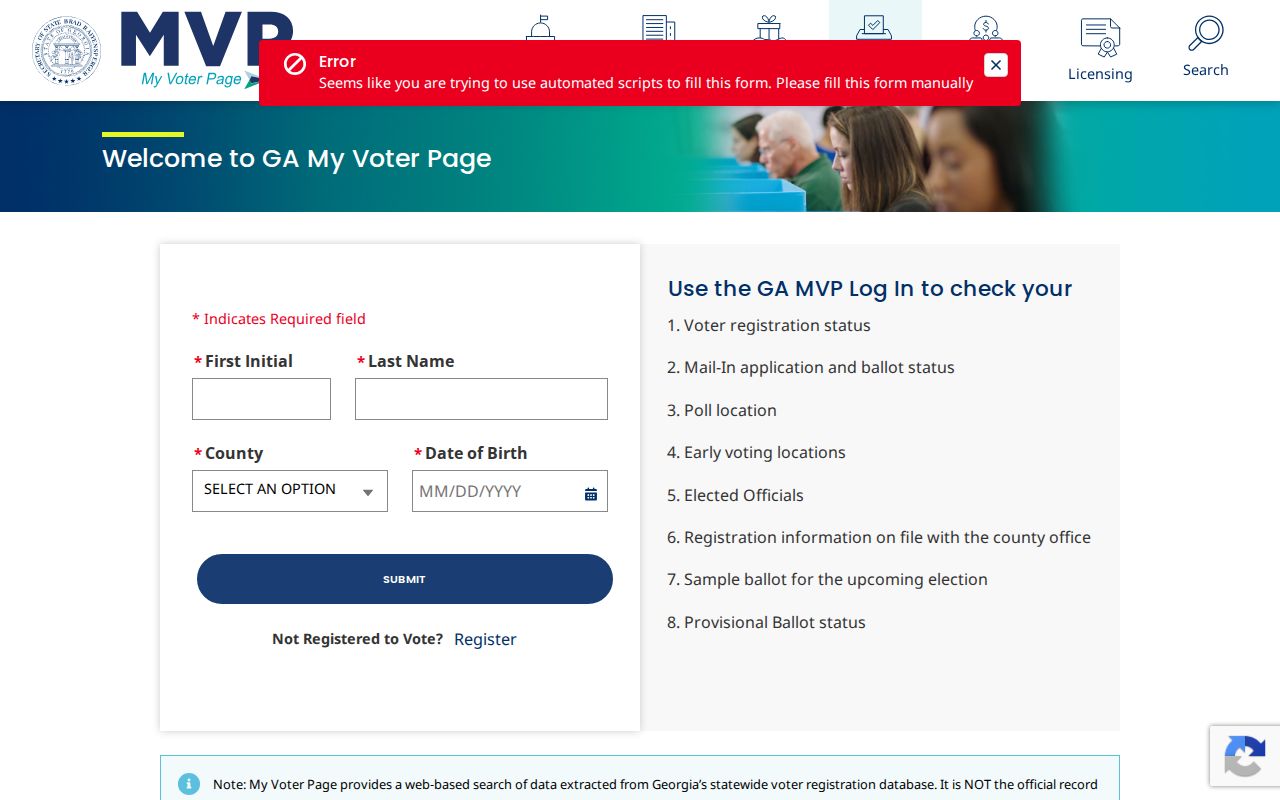
That form design explains why MVP confirms one person's record instead of publishing a searchable Duluth voter roll.
Duluth Voter Lookup Results
A matched MVP record brings several election tasks into one account-like view. The Secretary of State's registration guide says voters can see registration status, polling location, early-voting locations, elected officials, county-held registration information, a sample ballot, provisional-ballot status, and mail-in application and ballot status.
| Registration | Status and registration information maintained by the county. |
|---|---|
| Voting locations | Assigned poll and available early-voting locations. |
| Districts and officials | Electoral districts and the officials representing them. |
| Ballot tools | Sample ballot plus mail-in application and ballot status. |
| Provisional ballot | Status information when a provisional ballot was used. |
Georgia does not register voters by political party. Participation history can show that a voter received credit for taking part in an election, but never how the person marked a ballot. Those distinctions matter when reading voter records.
Note: A precinct card should arrive after registration; if it does not arrive within three to four weeks, check MVP or contact the county.
What Duluth Voter Records Reveal
Georgia voter records separate election administration facts from credentials used to prove identity. Depending on the product and lawful release rules, a record can include the voter's name, residence or mailing address, county and precinct, registration date and status, electoral districts, and election participation history. The current product specification controls the exact fields in any ordered file.
| Name | Name components and suffix may appear in a public voter product. |
|---|---|
| Address | Residence and mailing fields may appear, except where a protection program applies. |
| Location | County, precinct, and legislative or local districts may be included. |
| Party | Georgia does not register voters by political party. |
| Voting history | Shows election participation, never ballot choices. |
| Status | May show active, inactive, or cancelled, with registration date. |
Confidential by Georgia law. Full Social Security numbers, driver's-license or state-ID data, full birth dates, and protected-program addresses are not general public output under O.C.G.A. §§ 21-2-225 and 21-2-234.
Race, gender, birth-year, or age-related fields may exist inside election systems or in some products, but their public treatment must be checked against the current specification. Never assume that an internal field belongs in a public export.
Duluth Registration Correction Desk
Gwinnett Elections is the local authority for a Duluth record correction. The office maintains county registration information and can address a wrong name, residence, mailing address, precinct, or status. Start by saving the exact MVP result and noting what changed. A motor-vehicle transaction can affect registration information, so Gwinnett advises voters to verify MVP after dealing with the Department of Driver Services.
- Check the registered spelling, date of birth, and Gwinnett county selection in MVP.
- Compare the displayed residence, precinct, districts, and status with current facts.
- Contact Gwinnett Elections through the official county channel and ask what proof is needed for the correction.
- Return to MVP after processing and confirm the updated voter registration record.
Do not send a full Social Security number or identity-document image through an unverified email address. Use contact details reached from the official state or county election site.
Order Georgia Voter Registration Files
The Secretary of State makes voter lists orderable to the public through its official channel. Available product choices identified in the research include statewide and county voter registration lists plus statewide and county voter-history files. Choose the county product and Gwinnett when the task concerns Duluth. Product terms, geography, format, delivery, lawful-use certification, and fees control each order.
- Open the Georgia voter-list order page and select a registration-list or voter-history product.
- Choose statewide coverage or a county file. Select Gwinnett for Duluth-focused voter rolls.
- Provide the purchaser and contact details required by the current form, then review delivery and product choices.
- Read and sign the current use certification. Confirm the live fee before submitting payment.
No current fee was verified in the research, so an older price should not be used. The same caution applies to an assumed export layout. Confirm each field against the live specification before collecting or sharing it. General Georgia public-record rules are addressed with other Duluth public records procedures, while voter files remain subject to their election-specific statutes and order terms.
Duluth Voter Status Changes
Inactive does not mean automatically cancelled. That distinction is a key feature of Georgia voter registration maintenance. A record stays active when the voter has contact with the election system during the prior five years, including voting, requesting an absentee ballot, signing a petition, or updating an address through DDS or the election office.
Maintenance can begin after move evidence, returned confirmation mail, duplicate records, death information, felony-disqualification information, or other official data. Federal safeguards bar removal solely because a person did not vote. For move-based removal, the usual process requires notice and a waiting period spanning two federal general elections unless the voter confirms the move or another lawful ground applies. An inactive voter may still vote after the required affirmation or update.
Read each status as a dated administrative label. Active means the record has had qualifying contact. Inactive signals that confirmation steps may be pending, not that the voter has lost every right to cast a ballot. Cancelled is a different outcome and should be checked with the county when it seems wrong. Keeping the MVP result date with research notes helps prevent a later status change from being mistaken for an error in an older record.
The Georgia voter resources page explains registration status and current voter services.
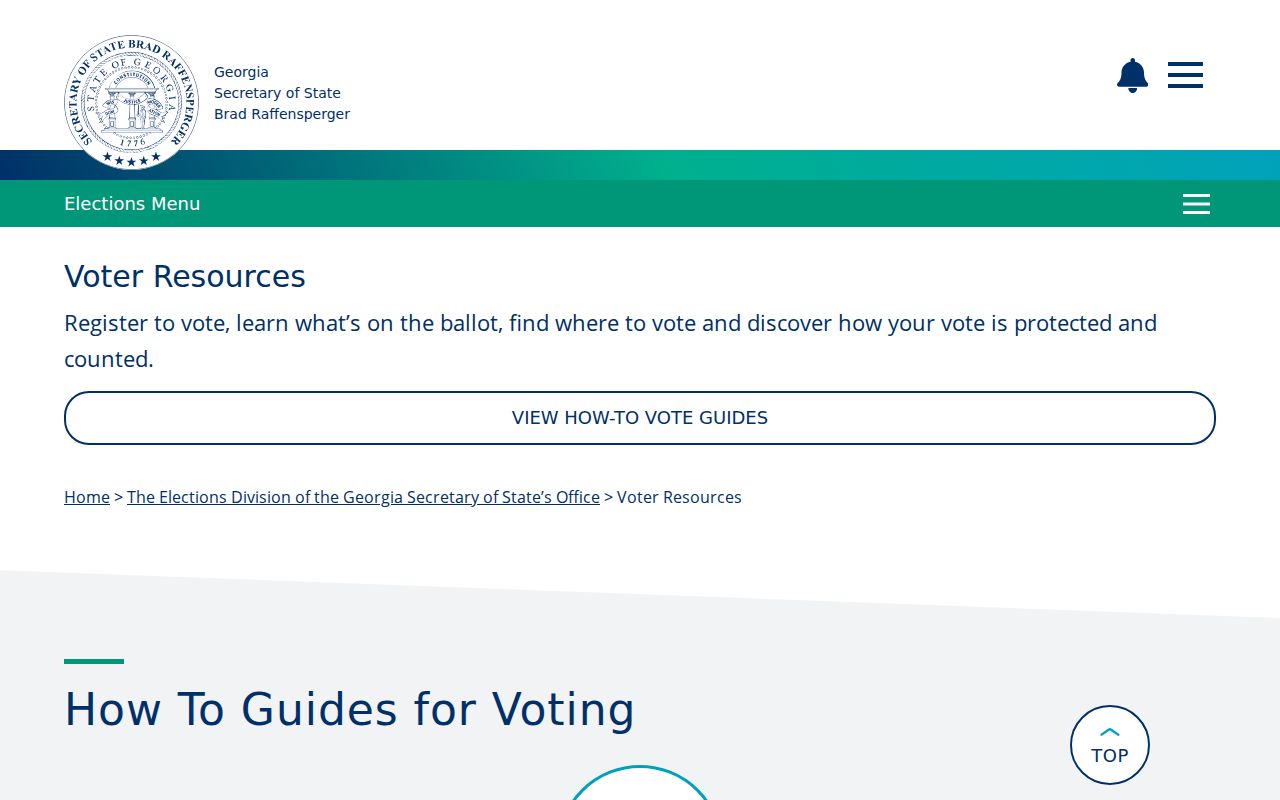
The state resource gives Duluth voters an official route to verify status rather than treating an inactive label as a final cancellation.
Protected Duluth Voter Addresses
VoteSafe and Georgia Safe at Home can shield address information for qualifying people. Safe at Home creates a substitute-address framework for eligible survivors affected by domestic violence, stalking, sexual assault, or human trafficking. A certified participant follows the program's voter registration process instead of placing a normal exposed residence address into routine agency records.
The Safe at Home program operates under O.C.G.A. § 19-13-30 et seq. It forwards first-class, certified, and registered mail sent through its system. Protection does not erase old deeds, court records, business filings, or other documents that predate participation. A participant should seek program-specific help instead of trying to remove an address through a standard voter-list request.
Note: Protected-address rules override ordinary voter-record access, so use the program office when a voter file and confidentiality status appear to conflict.
Historical Duluth Election Records
Current MVP records and old poll books answer different questions. A modern dashboard confirms today's registration and polling details. Historical poll lists, registration books, election returns, and newspaper precinct reports can place a person in an earlier election community or document local civic activity.
Search the Georgia Archives Virtual Vault and the Archives county microfilm catalog, then ask staff about Gwinnett poll lists, returns, and registration books. Exact Gwinnett poll-book coverage was not verified. That gap makes a catalog or staff request more reliable than claiming a fixed year range. Newspapers can add precinct totals and election reports, but they do not replace an official poll list.
When requesting archival help, give the person's full name, an estimated election year, the likely precinct or community, and any known address. Ask whether the item is indexed, digitized, on microfilm, or available only as an original volume. A return may summarize vote totals without listing voters, while a poll list or registration book is more likely to contain individual names. Record the series title, volume, page, and date for later verification.
Duluth was once known as Howell's Cross Roads, while Gwinnett records are centered in Lawrenceville. Older catalogs may therefore describe place and custody differently than a modern Duluth voter lookup.
Use Duluth Voter Records Lawfully
Public access does not permit stalking, threats, identity fraud, or harassment. Georgia stalking law includes O.C.G.A. § 16-5-90, and harassing communications are covered by O.C.G.A. § 16-11-39.1. Election statutes and the signed voter-file terms add record-specific limits. Follow the current order agreement and keep protected data out of notes, exports, and shared research.
Use limits follow the data. Obtain voter rolls only through official channels, honor the stated terms, and report suspected voter-data misuse to Secretary of State Elections or law enforcement.
For family or historical research, record only the facts needed to support a conclusion. Election participation is not a ballot choice, and an address in a dated file may no longer be current. Verify important details with Gwinnett Elections before relying on them.