
Duluth Public Records by Keeper
Most durable records tied to Duluth residents or property are held by Gwinnett County offices in Lawrenceville. Duluth City Hall keeps city administrative material, while Municipal Court and Police Records handle their own files. State agencies keep vital, correctional, business, and professional records. The table shows both the online path and the fallback when a portal does not provide the needed image.
| Record set | Custodian | Online index | Coverage | Access |
|---|---|---|---|---|
| Deeds, liens, plats | Gwinnett Superior Court Clerk | GSCCCA Real Estate | Surviving run starts Sept. 26, 1871 | Index and images; free office viewing |
| City administration | Duluth City Clerk | City request portal | Retention depends on series | Electronic request; exemptions apply |
| City court | Duluth Municipal Court | Request form | Not stated | Online, email, or mail |
| County cases | Responsible Gwinnett court clerk | County gateway and re:SearchGA | Varies by court and case | Index, then clerk or paid document access |
| Property roll | Gwinnett Tax Assessor | QPublic property search | Depth not stated | Free web search; office fallback |
| Birth and death | Georgia DPH or county vital office | Application, not a public name index | Statutory series | Eligibility, ID, and payment required |
An index is a finding aid, not the full record. It may show names, dates, and a reference number while leaving the image or certified copy with the clerk. A no-result response proves only that the selected system found no indexed match.
Three Duluth Records Request Routes
The City Clerk receives requests for Duluth government correspondence, minutes, contracts, boards, occupational-tax files, permits, and license material. Routine police reports do not go through that queue. Municipal Court files also have a separate custodian. An address-based request should begin with a city-limits check because a postal address labeled Duluth can lie in unincorporated Gwinnett County.
The official Duluth City Clerk request page shows that routing choice before submission.
The screen is useful because it keeps a city administrative request from being lost in the police or court channel. State the exact file series, dates, names, address, and preferred electronic format.
Jurisdiction first. A Duluth postal label does not establish city limits. Confirm the parcel before asking the city for permit or code records.
Duluth Deed Records Search Fields
The Gwinnett Clerk of Superior Court records deeds, security deeds, liens, plats, real-estate UCC material, executions, partnerships, and older physician registrations. Its statewide index is the main route for land documents. A grantor transfers an interest; a grantee receives it. Search both roles when tracing title.
| Field or mode | Type | Required | Use |
|---|---|---|---|
| County | Dropdown | Yes | Select Gwinnett for Duluth land |
| Name | Text | Search dependent | Grantor or grantee; try spelling variants |
| Instrument type | Dropdown | No | Limit to deed, lien, plat, or another class |
| Book/page | Paired text | No | Open a known record placement |
| Instrument number | Text | No | Direct document lookup |
| Recording dates | Date pair | No | Separate people with the same name |
The GSCCCA real-estate index displays the working search interface.
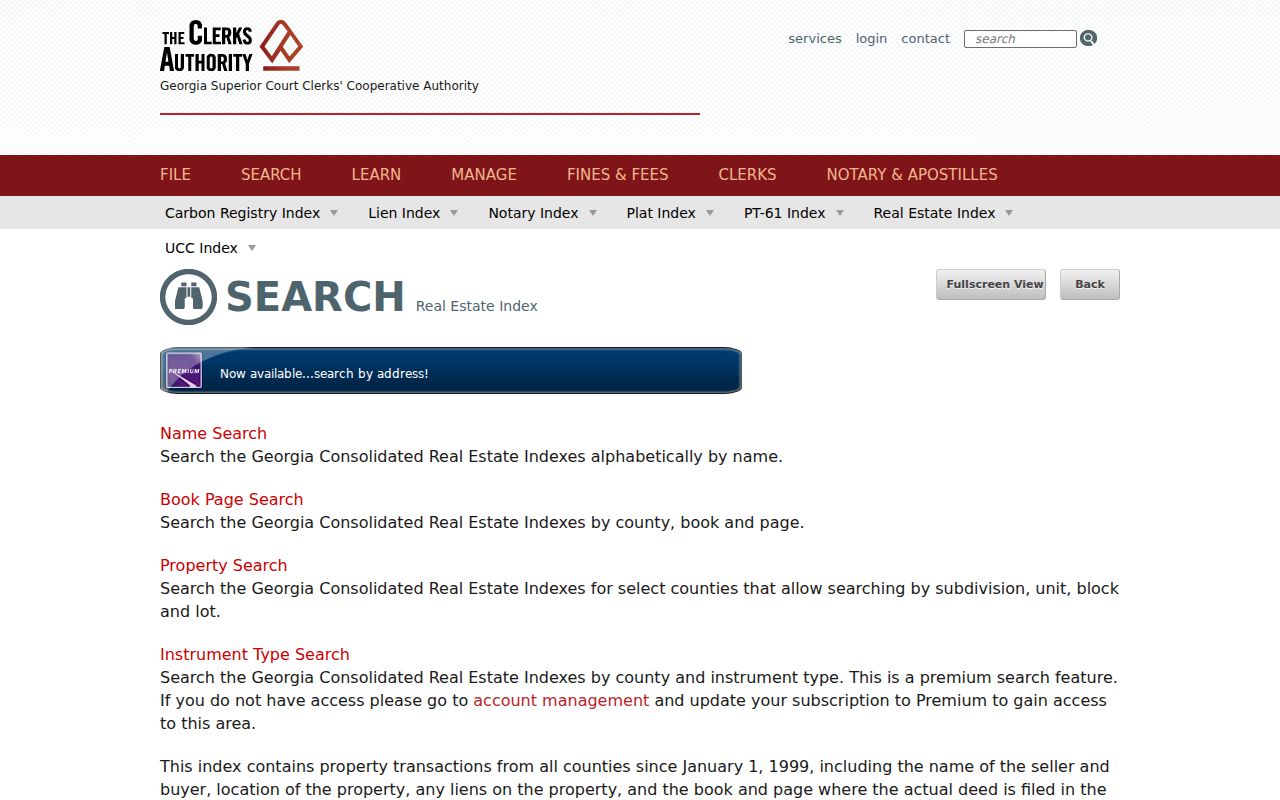
A result may show instrument type, recording time, book and page, instrument number, parties, cross-references, and an image link. Return and tax-bill addresses within a deed are not proof of residence.
Duluth Records Viewing and Copies
The Gwinnett Clerk allows free searching and viewing of recorded documents at 75 Langley Drive in Lawrenceville. Its counter is open weekdays from 8 a.m. to 5 p.m., with the recording counter closing at 4:30 p.m. Online GSCCCA access can require an account or charge for images. This is a useful distinction: inspection, an ordinary copy, and a certified copy are three different products.
- Index
- A searchable list pointing to a record by names, date, number, book, or page.
- Record image
- A scan of the filed document, which often contains more detail than the index.
- Certified copy
- A clerk-authenticated reproduction used when official proof is required.
- Custodian
- The agency or office responsible for keeping and responding for a record.
The Clerk FAQ and fee page describe copy prices differently. One quotes $2.50 for the first printed page and $1 for each later page; another lists ordinary copies at $1 and certification at $2.50 for the first page plus $1 for each additional page. Ask which current schedule applies before ordering. Filing fees, such as the $25 charge for many deeds and liens, are not search fees.
Duluth Court Indexes and Files
Duluth Municipal Court handles city ordinance and traffic matters. Gwinnett Magistrate, State, Superior, Probate, and Recorder's courts cover distinct county matters. Searching the wrong court can produce a false negative. The county portal may expose a case number, parties and roles, filing date, judge, status, events, hearings, and a public disposition, while pleadings or exhibits may still require a clerk request.
The Gwinnett court case-search gateway routes users to the relevant case systems.
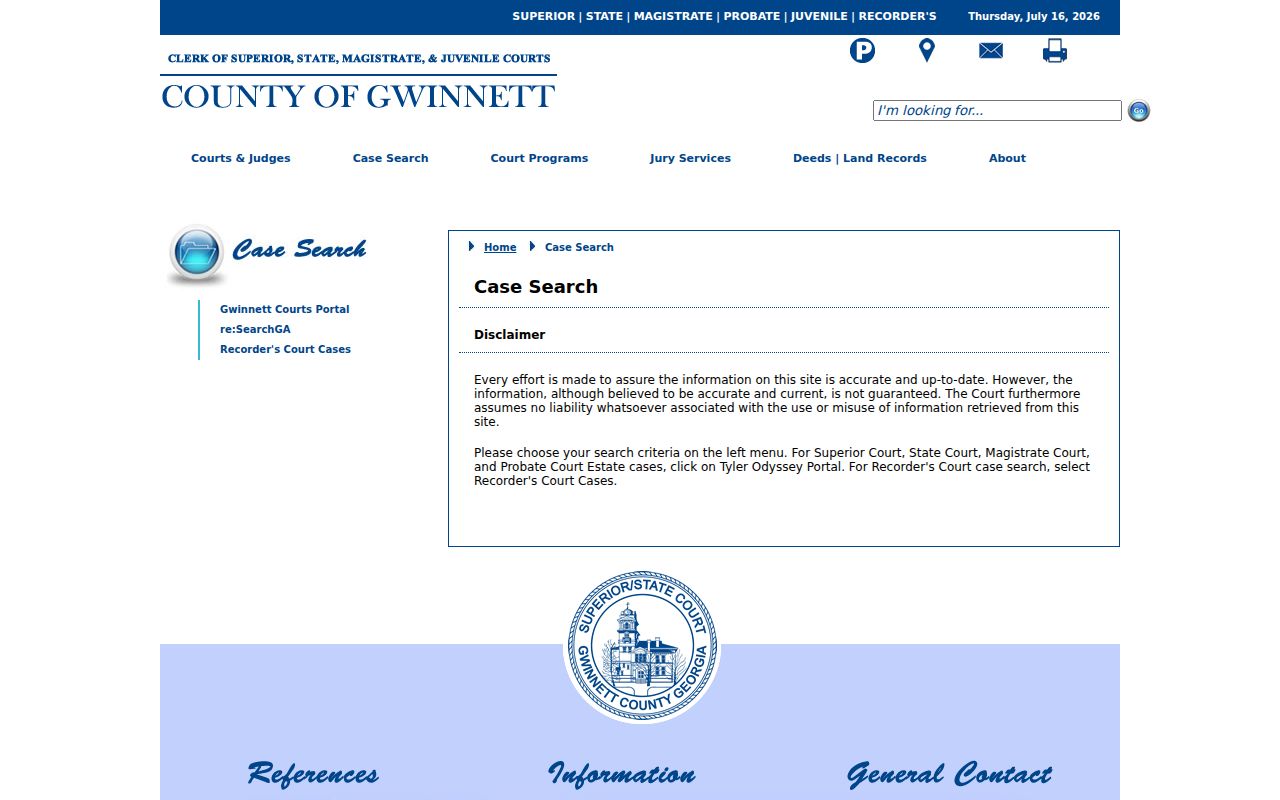
The gateway illustrates why “court records” are not one database. County tips recommend party names in Last, First form. Wildcards can broaden a partial name, while court and case-type filters reduce unrelated matches.
Municipal Court accepts requests online, by email at courts@duluthga.net, or by mail to 3276 Buford Highway, Duluth, GA 30096. Its record request page presents those channels.

Most requests have no standard charge, but the court reserves a 10-cent page fee and staff research charges after the first 15 minutes. A case or citation number sharply improves the request.
Duluth Property Records Need Context
The Gwinnett Tax Assessor connects owner names to parcels. Search by owner, street address, or parcel identifier. A parcel card can display owner, tax mailing address, property address, parcel number, legal description, values, exemptions, sale data, and a deed reference. The mailing address is where tax correspondence goes. The situs address is the physical location of the parcel.
Use the officially linked QPublic search, then check the county GIS browser for mapped boundaries and jurisdiction. GIS can search by PIN, owner, street, address, or intersection, but the county warns that the map is not a survey. The Assessor values property, the Tax Commissioner bills and collects, and the Superior Court Clerk records conveyances. Those offices answer different questions.
Note: A homestead code is dated assessment evidence, not conclusive proof that an owner lives at the property today.
Limits on Duluth Public Records
Georgia's access policy does not make every government file open. Social Security and taxpayer identifiers, account data, some birth-date information, medical material, protected investigative information, juvenile and adoption files, victim details, and confidential addresses may be withheld or redacted. Sealed court matters remain restricted. An agency should identify the specific legal basis and release separable, nonexempt portions.
Birth and death certificates are not unrestricted records under O.C.G.A. §§ 31-10-25 and 31-10-26. Eligibility depends on the certificate, the requester's relationship, and statutory purpose. The Georgia DPH request channel page compares mail, online, and county-office routes.
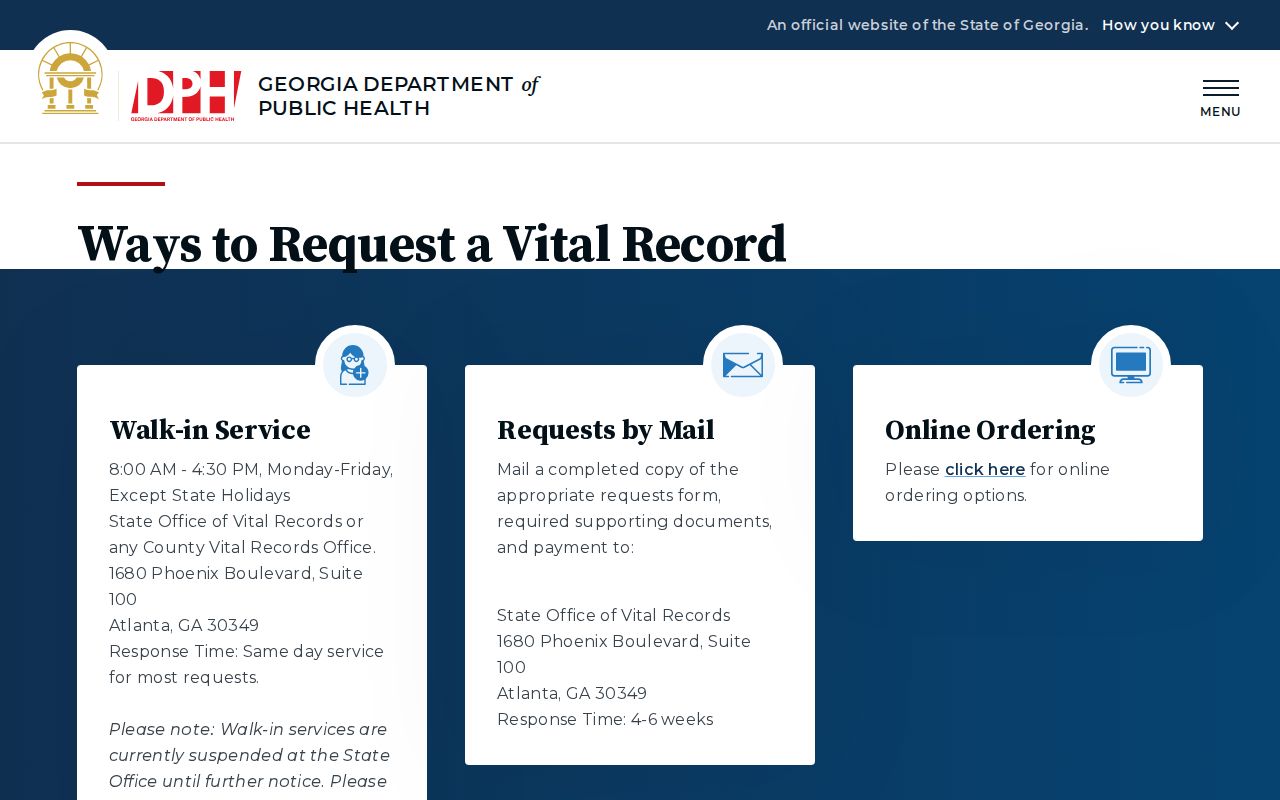
The state currently says its walk-in service is suspended until further notice and gives a four-to-six-week mail response estimate. County availability may differ. Current marriage records come from Gwinnett Probate Court, while divorce decrees come from the Superior Court clerk.
Why Duluth Deeds Start in 1871
Gwinnett's surviving deed run begins September 26, 1871 because fire destroyed former courthouse records. The break is especially important for Duluth's rail-era story: the railroad reached the area in 1871, just as local growth accelerated. A search that stops at the deed-series boundary should move to other record groups rather than assume every earlier trace vanished.
The Georgia Archives Virtual Vault has indexed Gwinnett marriage books for 1843 to 1866 and 1877 to 1892. County microfilm includes probate, court, tax, and deed material, while private manuscript collections preserve individual early deeds dating to 1821. Later deeds may also recite an earlier chain of title. Tax digests, marriage books, probate files, newspapers, and private papers can therefore bridge parts of the loss.
Note: The 1871 date describes the surviving land-record series, not every historical record connected with Gwinnett County.
New Duluth Real Estate Filings
Georgia changed how new real-estate documents reach the recorder. Gwinnett plats became electronic-only in 2017, central UCC filings followed in 2019, and all real-estate documents became subject to mandatory electronic filing through GSCCCA on January 1, 2025 under HB 1292. These milestones concern submission, not public inspection rights and not the start date for searchable images.
Older books and scans remain part of the records system. A modern electronic-filing requirement does not mean all past land records have identical online depth. For a missing image, use the index reference and ask the Clerk whether the document is available at the office, through GSCCCA, or in microfilm.
Georgia Records Response Rules
The Georgia Open Records Act, O.C.G.A. §§ 50-18-70 through 50-18-77, generally requires a response within three business days. That deadline is not always a completion date. If production is not practical within the window, the agency should describe the records, give a timetable and cost, or cite the basis for withholding.
No magic phrase or statement of purpose is required. A request should identify existing records instead of asking the office to answer questions or create a new report. Reasonable search, retrieval, redaction, and production costs may use the hourly rate of the lowest-paid qualified employee after the first 15 minutes. Standard letter or legal pages are generally 10 cents unless another law applies. Electronic delivery does not by itself justify a paper-copy fee.
When estimated charges exceed $25, an agency may require prepayment. Ask for native electronic format when that is how the file is maintained. If only part is exempt, request the segregable remainder. The Georgia Attorney General can offer open-government guidance, while superior court is the formal enforcement route.
Request Duluth Public Records Precisely
A focused records request saves both search time and cost. It also helps the office distinguish a Duluth city file from a Gwinnett land, court, or assessment record.
- Choose the custodian. Route city administration to the Clerk, routine police material to Police Records, court files to the correct clerk, and deeds to the Gwinnett Superior Court Clerk.
- Check the index. Capture the case, parcel, book/page, instrument, report, or citation number if one exists.
- Describe existing records. Give names, address, event type, and an inclusive date range. Ask for the maintained electronic format.
- Control cost. Request an estimate before chargeable work and say whether inspection, an ordinary copy, or certification is needed.
- Handle limits. If material is withheld, ask for the cited statute and all reasonably separable nonexempt portions.
Lawful personal use. Public access is not permission to stalk, threaten, intimidate, or harass. Georgia law penalizes such conduct even when an address was found in an open file.
Keep the response, estimate, and record reference together. Custody, ownership, license status, and case status can change, so note the date on which a portal or file was checked.